Watch the middle fill up
How to play plinko, step by step
A round takes a few seconds and there are three things to set before it starts. That is genuinely all of it — the difficulty is not the controls, it is knowing what each setting does to the outcome.

One board, fourteen bounces, fifteen slots
Before the round: three settings
The stake. A field with a minus and a plus, and usually a quick-double control. The board we looked at opened at ₹100 with the currency named in the field.
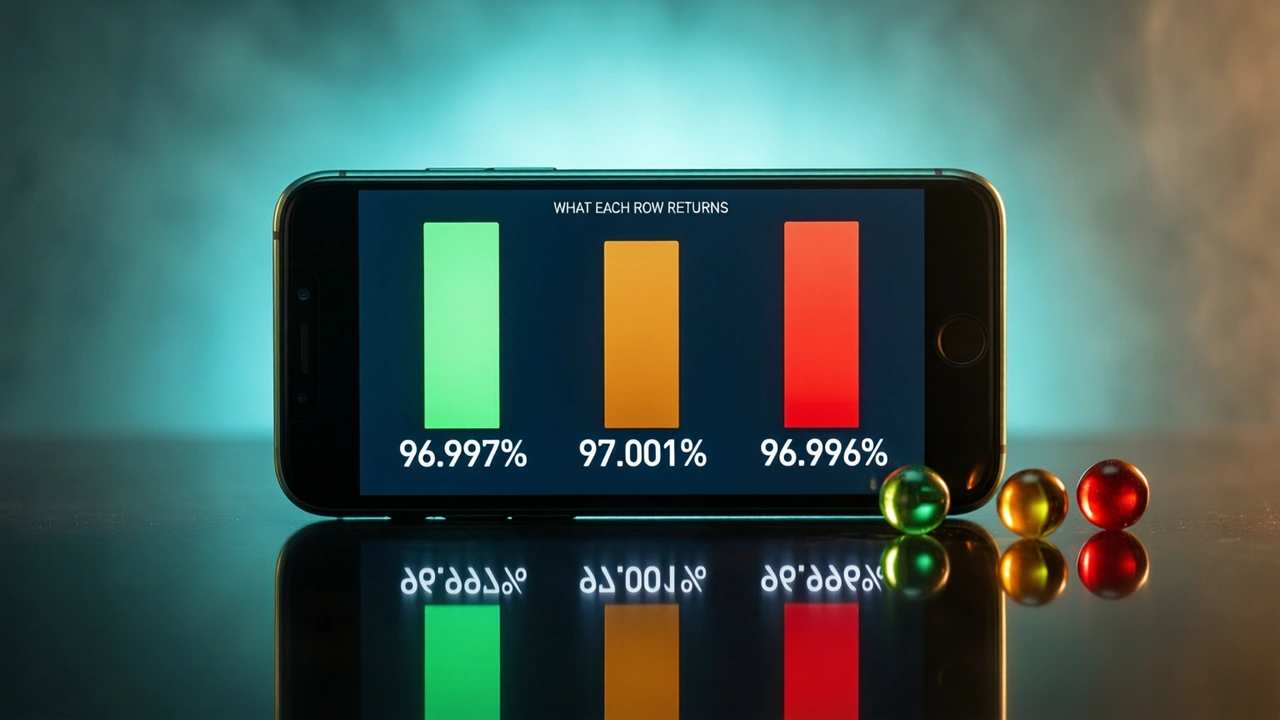
The payout row. Three buttons — green, amber, red — each switching the tiles under the board to a different ladder. Green pays little and often, red pays nothing often and enormously rarely. They return the same amount, which surprises most people.
The pin count. Not every build exposes this. More rows means more slots and a sharper distribution, and the ladder is rebuilt to match, so it changes the texture of the game rather than its return.
One board, fourteen bounces, fifteen slots
The round itself
Press the release. The ball enters above the top pin, goes left or right at each of the fourteen rows, and drops into one of fifteen slots. The tile it lands on is the multiplier; stake times multiplier is what comes back.
Nothing during the fall is under your control. There is no release angle, no timing window, no stop button. The mechanism is written out here.
One board, fourteen bounces, fifteen slots
After the round
Most builds keep a short strip of recent results along the top edge, and some show a running balance. The strip is a record, not a signal — a board has no memory between rounds, so nothing in it predicts the next one.
One board, fourteen bounces, fifteen slots
Practice mode first, and what it can show you
Boards usually open in a practice mode on credits that cannot be withdrawn. Two things are worth doing there before anything else.
Watch where the balls pile up. Thirty or forty rounds is enough to see the middle fill and the edges stay empty. That is the distribution making itself visible, and seeing it beats reading about it.
Switch rows and watch what changes. Green gives you a steady drip just under your stake. Red gives you a run of zeroes. Same board, same physics, different ladder.
One board, fourteen bounces, fifteen slots
What practice mode cannot show you
Your own conduct once a stake is genuine. Practice rounds rehearse the controls, which you will have learned in a minute anyway; they cannot rehearse the part that actually costs money.
It also cannot show you the cashier: deposit limits, withdrawal times and bonus terms are outside the game and have to be read where they live.
One board, fourteen bounces, fifteen slots
Playing on a phone
The board is wider than it is tall, so most lobbies turn it landscape. The tiles shrink accordingly, and on a small screen the difference between a 1.1× tile and a 1.6× tile is a few pixels. Worth zooming once at the start rather than guessing mid-session.
One board, fourteen bounces, fifteen slots
A short checklist
- 1Open the practice board and leave it on green for thirty rounds.
- 2Switch to red for thirty more and watch the zeroes.
- 3Read the ladder — the middle tile is the one that decides your session, not the edge one.
- 4Decide a stake and a stopping point before switching off practice.
- 5Check the lobby's cashier terms before the first deposit, not after.
If you want the welcome offer on the lobby we point at, the terms are laid out on the welcome pack page.
<p class="cta"><a href="https://gozzy.cc/click?ref=plinkoonline.in&lp=plinko" rel="nofollow sponsored">Claim 500% Welcome Pack</a></p>