Watch the middle fill up
Can you make a plinko round go your way
Search how to win plinko and you get strategy pages. Almost all of them are describing bet sizing, which changes how fast money moves, not how much of it comes back.
The honest answer is shorter than a strategy guide, and it is arithmetic rather than opinion.
One board, fourteen bounces, fifteen slots
The three rows, read off a live board
Fourteen rows of pins, fifteen slots. Each row of tiles is symmetrical about the centre, smallest in the middle, largest at the two ends.
| Slot | Green | Amber | Red |
|---|---|---|---|
| Centre | 0.5× | 0.2× | 0× |
| ±1 | 1× | 0.7× | 0.2× |
| ±2 | 1.1× | 1× | 0.5× |
| ±3 | 1.2× | 1.6× | 2.1× |
| ±4 | 1.3× | 3.2× | 5.3× |
| ±5 | 1.6× | 5.6× | 14× |
| ±6 | 3.2× | 12× | 49× |
| ±7 (edge) | 18× | 55× | 353× |
One board, fourteen bounces, fifteen slots
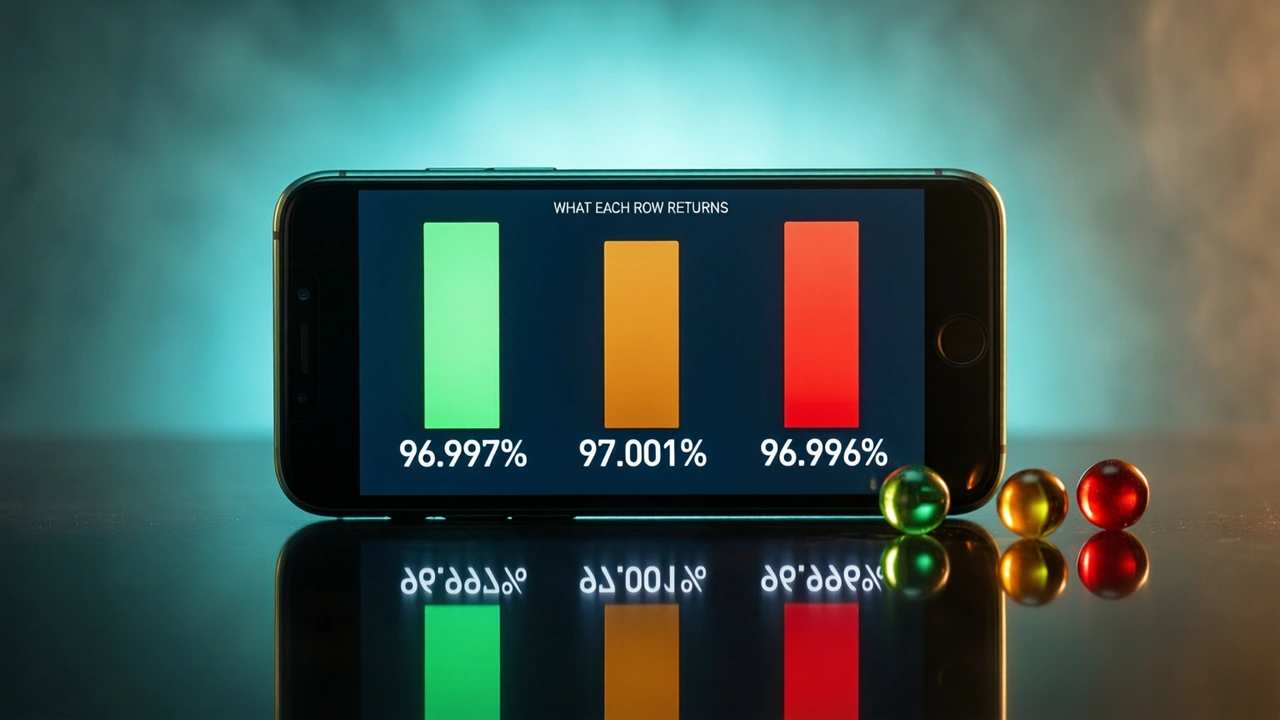
What each row returns
Take the chance of each slot, multiply by what that slot pays, add up all fifteen. That number is what the row gives back per unit staked over a long run.
| Row | Return |
|---|---|
| Green | 96.997% |
| Amber | 97.001% |
| Red | 96.996% |
Three ladders with nothing visually in common, agreeing to within five thousandths of a percentage point. They are built to a shared target and then spread differently.
So the row you choose does not change what you get back. It changes the shape: green pays small amounts constantly, red pays nothing most of the time and occasionally pays a great deal.
One board, fourteen bounces, fifteen slots
The assumption this rests on
Every number above comes from treating each bounce as an even split — left or right, fifty-fifty, each row independent of the last. That is the standard model for a pin board, and the fact that three very different ladders land on the same figure is strong evidence the ladders were designed against exactly that model.
We have not measured the physics of any particular build. So: this is what the published ladders return on a fair board. It is not a provider's stated figure, and we would not print one we had not seen.
One board, fourteen bounces, fifteen slots
What the big multiplier is actually worth
The 353× tile is the reason people pick the red row. Its contribution to that row's return is 4.4%.
| Row | Share of return coming from the two edge slots |
|---|---|
| Green | 0.2% |
| Amber | 0.7% |
| Red | 4.4% |
Over 95% of every row's return comes from the crowded middle slots paying 0.2×, 0.5× and 1×. The edge tile is a headline, not an engine.
And on the red row the middle is where the zero sits. The single most likely outcome — a round in five — returns nothing.
One board, fourteen bounces, fifteen slots
What actually changes your result
Number of rounds. More rounds pulls the outcome closer to 97%, which is a loss. Fewer rounds keeps variance high, which is the only thing that ever produces a win.
Stake size. Changes how much you can be down before you stop. Does not touch the percentage.
The row. Changes the distribution's shape. Does not touch the percentage.
Nothing else on the screen. Not release timing, not the last round's slot, not a pattern in the history strip.
One board, fourteen bounces, fifteen slots
Systems that do not work, and why
Doubling after a loss fails because the board has no memory — the next round's odds are identical to the last one's, and the sequence ends at the table limit or at your balance, whichever comes first.
"Due" slots fail for the same reason. A round in which the edge has not appeared for eight thousand tries is exactly as likely to produce the edge as the first round was.
Paid predictors and hack apps fail because there is nothing in a fourteen-bounce board to predict and nothing exposed to the client to hack. What they do reliably produce is a payment, and sometimes an install you did not want.