Watch the middle fill up
How the board decides where a ball lands
The question behind how does plinko work is usually narrower than it sounds. People are not asking about pixels. They want to know whether anything in the round is decided while it is happening, and if not, what decides it.

One board, fourteen bounces, fifteen slots
One pin, one decision, fourteen times
A ball is released above the top pin. It strikes the pin and passes to the left or to the right. One row down it strikes another pin and does the same. The board on the lobby we looked at is set to fourteen rows, which is adjustable on some builds.
After fourteen of these the ball is out of pins and drops into a slot. There are fifteen slots, because fourteen left-or-right decisions can produce fifteen different totals.
That is the mechanism in full. No part of it is steered after release.
One board, fourteen bounces, fifteen slots
Why the middle fills up
If left and right are equally likely, the slot is decided by how many times "right" happened out of fourteen. Landing in the far left slot means every single bounce went left — one sequence out of 16,384. Landing in the centre means exactly seven went each way, and there are 3,432 sequences that do that.
Counting the sequences gives the shape of the board:
| Distance from centre | Share of rounds | Roughly |
|---|---|---|
| 0 | 20.9% | one round in five |
| 1 | 18.3% | one in five |
| 2 | 12.2% | one in eight |
| 3 | 6.1% | one in sixteen |
| 4 | 2.2% | one in forty-five |
| 5 | 0.56% | one in 180 |
| 6 | 0.085% | one in 1,170 |
| 7 | 0.006% | one in 16,400 |
Watch a practice board for a few minutes and you will see this happen in front of you: a dense pile in the middle, a thin scatter outwards, and the outer slots untouched.
One board, fourteen bounces, fifteen slots
The payout ladder sits on top of that shape
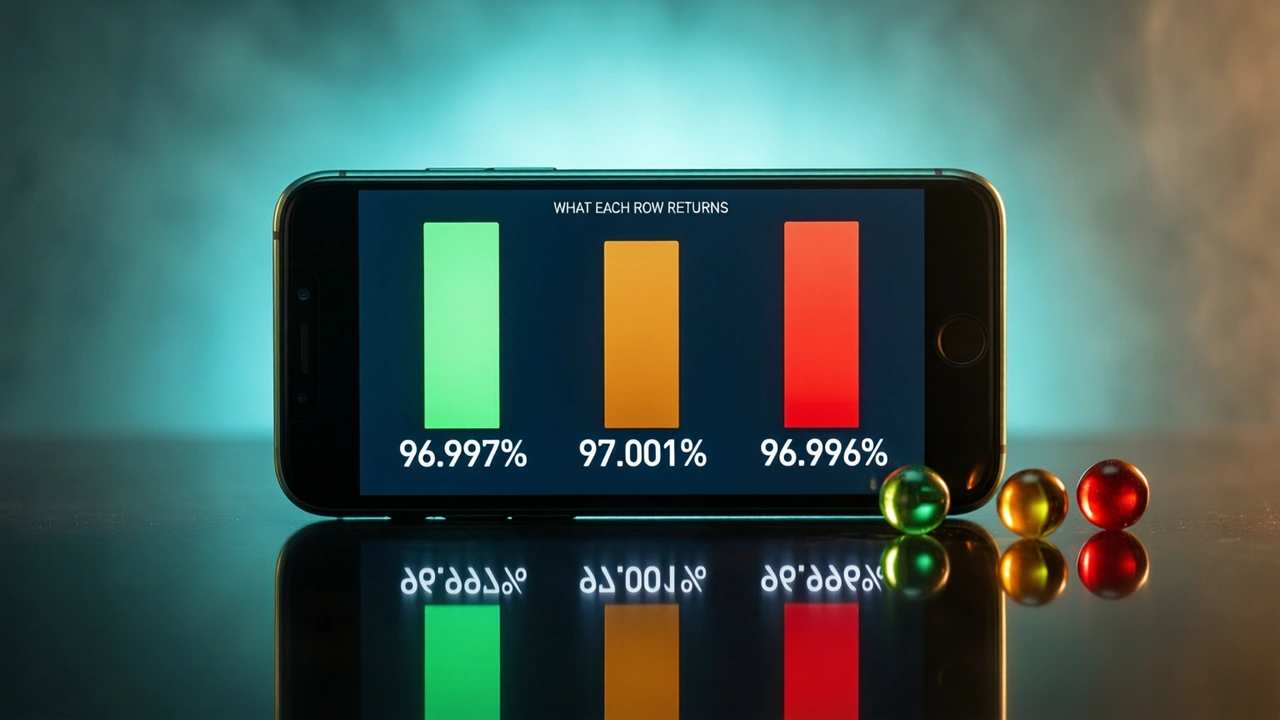
The board does not change the odds when you change rows. It changes what each slot pays. Three ladders, one distribution underneath — which is why they can all return the same amount while looking completely different. That calculation is on its own page.
The practical consequence: a row with a huge edge multiplier has to pay less somewhere, and the place it pays less is the middle, which is where the ball almost always goes.
One board, fourteen bounces, fifteen slots
What "provably fair" does and does not mean
Some builds publish a server seed, a client seed and a nonce, and let you verify after the fact that the round's result was fixed before you saw it. Where that exists, it is worth using: it answers "was this round decided in advance" with arithmetic instead of trust.
It does not answer "is the ladder generous". A round can be perfectly verifiable and still sit on a ladder that returns 97%. The two questions are separate, and pages that blur them are usually selling something.
One board, fourteen bounces, fifteen slots
What a round cannot be influenced by
Not the timing of the release. Not the row you picked last time. Not how many rounds have passed since the edge slot last came up — each round starts from nothing, and the board has no record of the previous one.
The last of those is the one that costs people money, and it is common enough to have a name: the gambler's fallacy. A slot being "due" is not a property boards have.
One board, fourteen bounces, fifteen slots
Where the pin count matters
Raising the pin count adds rows, which adds slots and sharpens the shape: the middle gets relatively more traffic and the edges get rarer still, so the ladder is rebuilt to match. Lowering it flattens the distribution.
It is a real setting with a real effect, but it is not a lever that improves the return — the ladder moves with it.