Watch the middle fill up
Mines, dice and a falling ball
Lobbies file these three in the same drawer, usually labelled instant or originals. A round in each takes seconds, none of them has reels, and all three publish a return figure in the high nineties.
Underneath they are built on different questions, and the difference decides what a player can actually do.
One board, fourteen bounces, fifteen slots
Where the decision sits
Dice. You choose the threshold before the roll: over this number, under that one. The chance and the payout move together — pick a harder target and you are paid more for it. One decision, made once, and it is made before anything happens.
Plinko. You choose the payout row before the drop. The distribution underneath is fixed by the pin count and does not move. One decision, made once, before anything happens.
Mines. You choose a tile, see a result, and then choose whether to continue. That is a decision made during the round, repeatedly, with information you did not have at the start.
That last line is the whole difference. Two of these three games are settled before you are allowed to do anything; the third asks you a question after every tile.
One board, fourteen bounces, fifteen slots
What "you cannot influence it" means in each
On a dice round and on a plinko drop, the phrase is literal. Once the round starts there is no input. A plinko ball takes fourteen left-or-rights and lands; nothing about the fall is exposed to the player.
On mines, the phrase is false in an interesting way. You cannot influence where the mines are — that is fixed when the grid is dealt. You can influence how much of your own exposure you take, by stopping. The mine positions are not yours; the number of tiles you turn over is.
One board, fourteen bounces, fifteen slots
Does that make mines a skill game
No, and the distinction is worth stating carefully.
Stopping earlier or later does not improve your long-run return. The payout ladder in mines is built so that each additional tile pays exactly enough to keep the return flat. What stopping changes is the shape of the outcome — frequent small wins against rare large ones — which is the same lever plinko gives you with its three rows, just pulled at a different moment.
On plinko you pick the shape once, before the round. On mines you pick it continuously, during. In neither case does the choice move the percentage.
One board, fourteen bounces, fifteen slots
The return figures look alike and mean the same thing
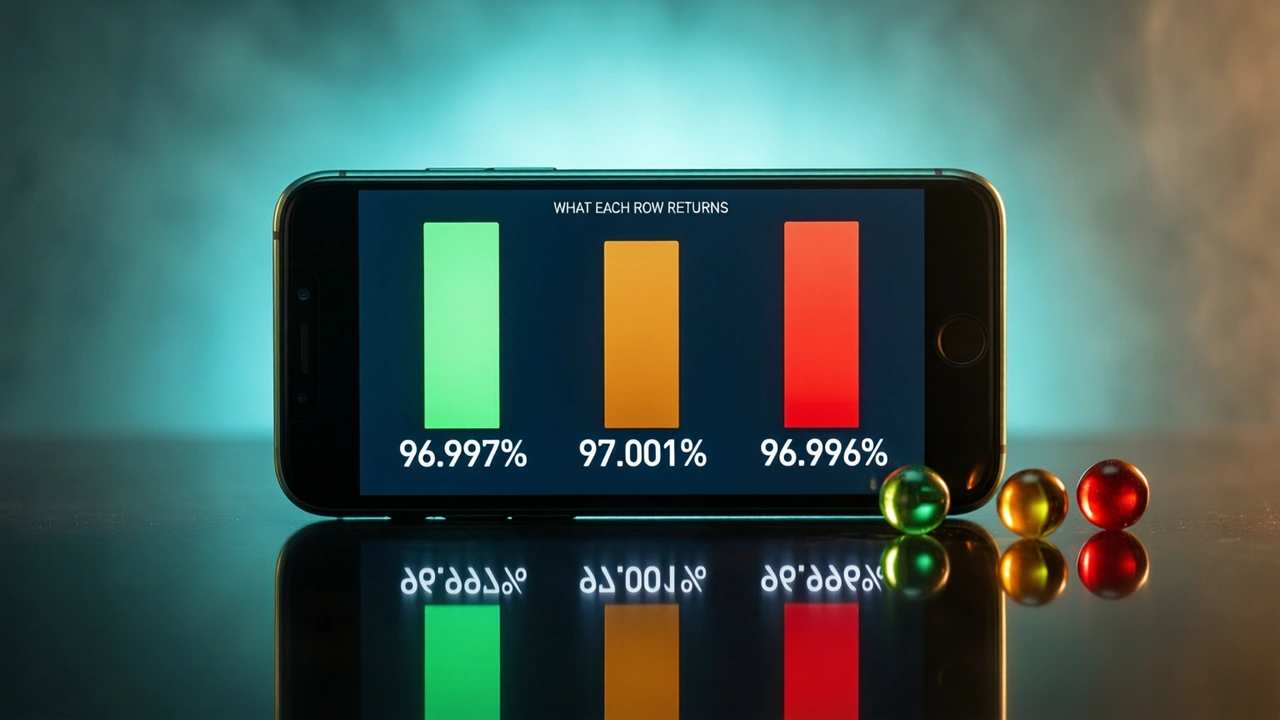
Three ladders read off a live plinko board return 96.997%, 97.001% and 96.996%. Dice and mines lobbies typically publish figures in the same neighbourhood. That similarity is not a coincidence — these are all games designed to a house margin of two or three percent, and the margin is the product.
What differs is variance. A dice round at a near-even threshold and a plinko drop on the green row both feel like small, frequent movements. A dice round at a 100× threshold and a plinko drop on the red row both feel like long droughts and rare spikes. Same return, different experience, and the experience is what people are actually choosing between.
One board, fourteen bounces, fifteen slots
The one that is genuinely different
Of the three, plinko is the only one where the probability distribution is visible while you play. Watch a board for a few minutes and the balls pile up in the middle in front of you.
Dice hides its distribution behind a slider. Mines hides it behind a grid. Plinko draws it.
That visibility is the best thing about the game and it is routinely wasted, because the distribution being obvious does not stop anyone looking at the 353× tile at the far edge — the one the balls are visibly not reaching. What that tile is actually worth is about four percent of the row's return.
One board, fourteen bounces, fifteen slots
If you are choosing between them
Ask what you want the decision to feel like. Set-and-watch is plinko or dice. Decide-as-you-go is mines. None of the three pays better than the others, and any page telling you otherwise is comparing marketing copy rather than ladders.