Watch the middle fill up
How a television pricing game became a casino tile
Dated changes to the board itself, not a brand story.
-
1983
A board on a television stage
Plinko is first played on The Price Is Right on 3 January, devised by the show's executive producer Frank Wayne and named after the sound a disc makes coming down a board of metal pins.
- Nine slots, each holding a cash amount
- The largest amount sits in the middle
- Discs are earned by pricing small prizes
-
1983–1992
The prize keeps climbing
The top slot opens at $25,000 — the most the network's rules then permitted — and is raised in steps until it reaches $125,000, by which point Plinko is the show's best-known segment.
- $50,000 in 1984, $75,000 in 1986
- $100,000 in 1990, $125,000 in 1992
- A prize game, with nothing staked
-
Screen version
The slots start holding multipliers
The shape survives intact and the payout inverts. Cash amounts become multipliers of whatever was staked, and the biggest ones move out of the centre.
- Largest multipliers move to the two outer slots
- Outer slots are reached about once in 8,000 rounds
- The centre now pays less than the stake
-
Today
Three ladders over one distribution
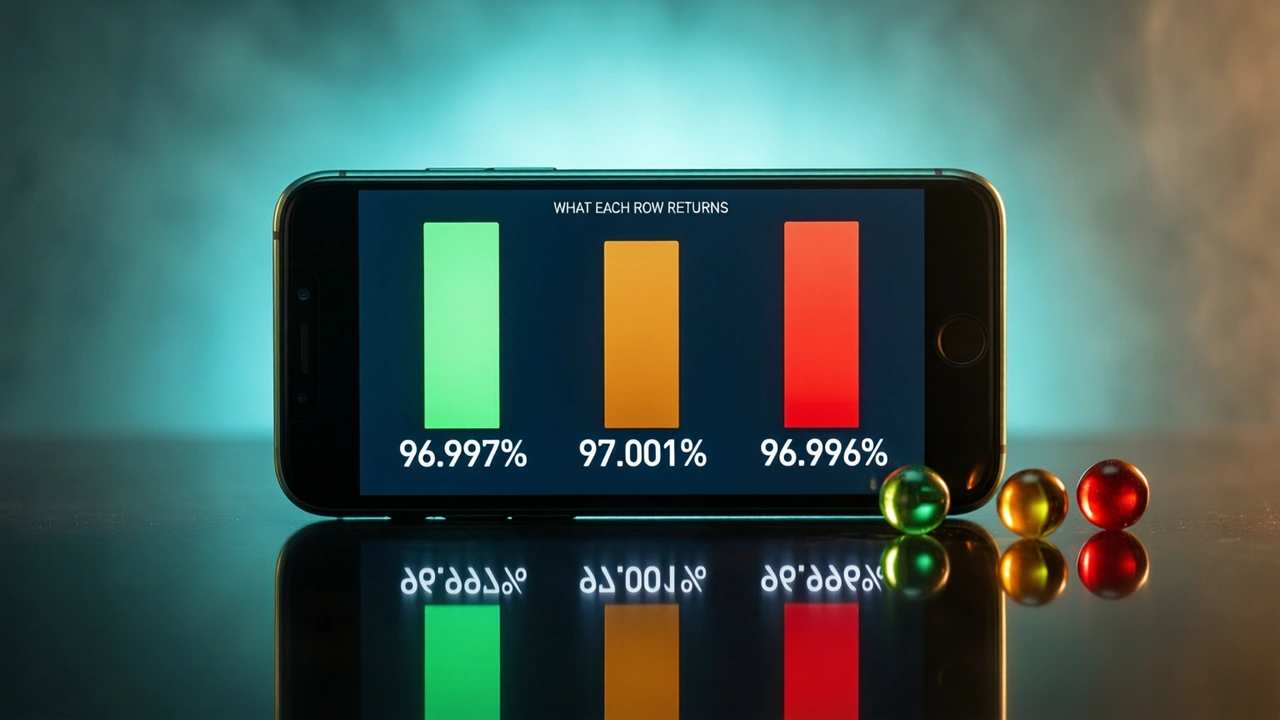
A fourteen-row board offers green, amber and red payout rows at once. They look nothing alike, and they return the same.
- 96.997%, 97.001% and 96.996%
- The row changes the shape, not the average
- On the red row the centre slot pays nothing
14
rows of pins
15
slots at the bottom
20.9%
of rounds land dead centre
97%
what every payout row returns
Plinko casino: what one round actually settles
One ball, fourteen rows of pins, fifteen slots at the bottom. That is the whole machine. Everything else on the screen — the colours, the row you picked, the number glowing in the corner — is a way of describing what happens to that ball.
Most pages about this game describe the buttons. This one describes the arithmetic, because the arithmetic is short enough to state in full and it answers the questions people actually type.
One board, fourteen bounces, fifteen slots
Fourteen bounces and nothing else

The ball enters at the top and meets a pin. It goes left or right. It meets another pin one row down and does the same thing, fourteen times, and then it is in a slot.
There is no aiming, no timing, no release point you control. How the board decides where a ball lands walks through it row by row, but the short version is that a round is fourteen independent coin flips and the slot is the running total.
That single sentence explains almost everything people find confusing about this game, including why the middle slots fill up and the edges almost never do.
One board, fourteen bounces, fifteen slots
Where the ball actually lands

With fourteen rows there are fifteen slots, and they are not equally likely. Landing dead centre needs seven lefts and seven rights in any order, and there are a great many orders. Landing at the far edge needs fourteen of the same in a row, and there is exactly one.
| Distance from centre | 0 | 1 | 2 | 3 | 4 | 5 | 6 | 7 |
|---|---|---|---|---|---|---|---|---|
| Share of rounds | 20.9% | 18.3% | 12.2% | 6.1% | 2.2% | 0.56% | 0.085% | 0.006% |
Two thirds of all rounds finish in the five middle slots. The outer slot on either side comes up about once in eight thousand rounds — and the payout tile sitting there is the one the screen is designed to make you look at.
One board, fourteen bounces, fifteen slots
The three payout rows are one choice, not three games
The board offers three rows of tiles at once, green, amber and red, and a button for each. They are not difficulty settings on separate games. They are three different payout ladders over the same fourteen bounces.
Read off a live board, they run like this:
| Row | Centre slot | Edge slot |
|---|---|---|
| Green | 0.5× | 18× |
| Amber | 0.2× | 55× |
| Red | 0× | 353× |
Now put the two tables together. On the red row, the slot that comes up in one round out of five returns nothing at all. The most likely single outcome of picking the highest payout row is losing the stake outright.
One board, fourteen bounces, fifteen slots
They all return the same

Multiply each slot's chance by what it pays and add up the fifteen results, and the three rows come out as:
- green — 96.997%
- amber — 97.001%
- red — 96.996%
Three ladders that look nothing alike, agreeing to within five thousandths of a percent. That is not a coincidence; the ladders are built to a shared target and then spread differently. Picking red does not improve what you get back on average. It moves the same average into rarer, larger payouts and more frequent zeroes.
This is worked out in full on what changes a plinko result and what does not, including the one assumption the whole calculation rests on.
One board, fourteen bounces, fifteen slots
What the number at the edge is worth

The 353× tile is the loudest thing on the red row and it contributes 4.4% of what that row pays back. On the amber row the edge tiles are worth 0.7% of the return; on green, 0.2%.
Almost the entire return of every row comes from the boring middle slots — the ones paying 0.2×, 0.5× and 1×. The headline number is real, it is just not where the money is.
One board, fourteen bounces, fifteen slots
Fun mode is a real thing and a limited one

Most builds open in a practice mode with credits that cannot be withdrawn. It is genuinely useful: it shows the ladder, the pin count and the speed of a round without costing anything, and it is the fastest way to see for yourself that the middle fills up.
What it cannot show you is your own behaviour when a stake is real. That is the gap worth being honest about, and it is the reason the practice board is a tool rather than a rehearsal.
One board, fourteen bounces, fifteen slots
Where this game comes from

Plinko was not invented for casinos. It began as a pricing game on the American television show The Price Is Right, first played on 3 January 1983, devised by the show's executive producer Frank Wayne. The name is the sound a disc makes coming down a board of metal pins.
The screen version borrows the shape and changes the stakes. Where plinko came from covers the original board, and a cardboard board and a screen are not the same game covers what is different about playing it at home.
One board, fourteen bounces, fifteen slots
Where to play it

Lobbies carrying this game are ordinary casino lobbies; the game is one tile among hundreds. Where to play plinko lists what to check before you pick one, and the named versions sorts out which of the similar-looking titles are actually different games.
If you want the welcome offer on the lobby we point at, it is set out on the welcome pack page — figures, wagering and the parts that are easy to misread.
<p class="cta"><a href="https://gozzy.cc/click?ref=plinkoonline.in&lp=plinko" rel="nofollow sponsored">Claim 500% Welcome Pack</a></p>